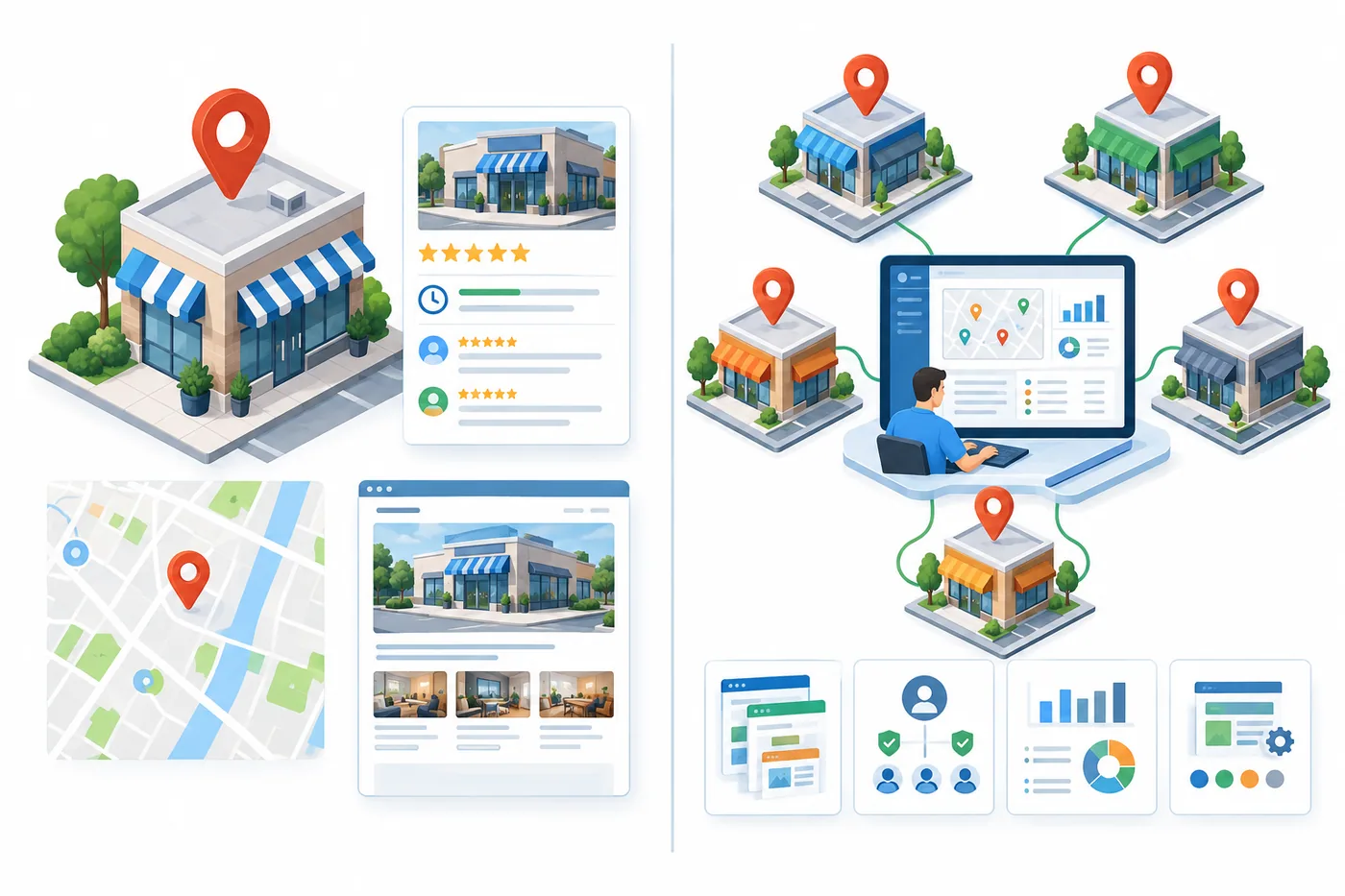
Local SEO focuses on one business location. Franchise SEO coordinates local search across a network. The difference is not simply the number of Google Business Profiles or location pages. It is the operating model behind them: shared standards, local relevance, access controls, technical templates, review processes, and reporting that can work at scale.
For a single shop, clinic, restaurant, or service-area business, local SEO may be managed as a focused checklist. A franchise owner or multi-unit operator needs the same fundamentals, but also needs to decide what is centralised, what each location can change, and how problems are found before they affect several markets. This guide explains the distinction and gives you a practical way to choose the right structure.
Local SEO: the location-level job
Local SEO improves how a business appears when people search for a service in a defined area. The work usually includes:
- Keeping the Google Business Profile accurate.
- Using the correct name, address, phone, hours, categories, and services.
- Building a useful location or service-area page.
- Publishing genuinely local information where it helps customers.
- Monitoring reviews and responding appropriately.
- Checking local listings for incorrect or conflicting information.
- Measuring calls, directions, form submissions, and other meaningful actions.
The emphasis is relevance and accuracy for one market. A Winter Park location may need content and service details that differ from a Kissimmee location, even when both follow the same brand identity.
Franchise SEO: the network-level operating system
Franchise SEO includes those location-level tasks, then adds coordination. The central question changes from “How do we improve this listing?” to “How do we improve every eligible location while preventing errors, duplication, and uneven execution?”
A coordinated program typically defines:
- Ownership: Who controls profiles, website templates, citations, reviews, and analytics?
- Standards: Which business information, brand language, imagery, and page elements must stay consistent?
- Local permissions: What can an Orlando, Lake Nona, or Altamonte Springs operator update without approval?
- Technical structure: How are location URLs, internal links, schema, canonicals, sitemaps, and redirects managed?
- Change management: How are openings, closures, relocations, rebrands, and temporary hour changes handled?
- Measurement: How are location-level outcomes reported without hiding weaker markets inside a network average?
That is why franchise SEO is better understood as an operating system than as a larger keyword list. It needs repeatable processes and clear exceptions.
Local SEO vs franchise SEO at a glance
| Area | Local SEO | Franchise SEO |
|---|---|---|
| Primary scope | One location or service area | Many locations under one brand |
| Profile management | One listing and its reviews | Profile governance, access, bulk updates, and exceptions |
| Website | One strong local page or small site | Reusable architecture with unique, useful location content |
| Brand control | Usually simple | Central rules plus approved local flexibility |
| Technical risk | Errors affect one market | One template or deployment can affect many markets |
| Reporting | One market’s calls, leads, and visibility | Network rollups plus location-by-location diagnosis |
What stays centralised
Centralisation reduces duplicated work and limits preventable errors. Most franchise organisations should keep these areas under a shared process:
- Website architecture, URL conventions, redirects, and technical SEO checks.
- Brand name rules and core business information.
- Tracking definitions, analytics access, and reporting templates.
- Location-page templates and quality requirements.
- Google Business Profile ownership and permission standards.
- Review escalation rules for legal, safety, or customer-service issues.
- New-location launch checklists and closure procedures.
Central control does not mean every page should sound identical. It means the rules are deliberate and visible.
What should stay local
Searchers need evidence that a location serves their area. Local operators or market owners may supply details that a central team cannot invent:
- Accurate local hours, parking instructions, service boundaries, and accessibility information.
- Local staff or provider details when appropriate and permitted.
- Market-specific services, inventory, appointment availability, or delivery areas.
- Responses to ordinary customer reviews.
- Community involvement and locally relevant updates that are real and verifiable.
The safeguard is a review workflow. Local flexibility should add truth and usefulness, not create unsupported claims or inconsistent business information.
Location pages are not copy-and-paste templates
A franchise website often needs a page for each legitimate location. But duplicating the same paragraph and swapping the city name does not create useful local content. A good location page should help someone decide whether that specific location can serve them.
Depending on the business, useful details may include the address, hours, phone number, services available there, access or parking information, service boundaries, appointment process, staff information, photos, and locally accurate FAQs. Do not create pages for locations that do not exist or areas the business does not genuinely serve.
Templates are valuable for consistency. They should provide structure, not replace local facts.
Google Business Profile management becomes a governance issue
For one location, profile maintenance can be a recurring task on an owner’s calendar. Across a network, you need an inventory and an escalation path. Start with a spreadsheet or system that records each location’s official name, address, phone, URL, categories, hours, opening status, profile owner, and last review date.
Then define who can make changes. A central team may handle primary details and suspensions. A local operator may propose holiday hours or answer reviews. The exact division depends on the business, but undocumented access creates risk when staff leave or locations change hands.
How to measure the difference
Do not judge a franchise SEO program only by a network-wide average. A strong dashboard separates operational coverage from business outcomes.
| Measurement layer | Questions to answer |
|---|---|
| Coverage | Are all active locations represented with accurate pages, profiles, hours, and tracking? |
| Visibility | How do important non-branded searches perform by market and location? |
| Engagement | Are calls, direction requests, form submissions, and appointment actions being recorded? |
| Quality | Which locations have broken pages, duplicate listings, missing details, or unresolved reviews? |
| Business fit | Are leads reaching locations that can actually serve the customer? |
Use comparable dates, locations, and queries when reviewing trends. A sparse snapshot can make a change look larger than it is. Keep a record of site releases, profile changes, seasonality, and market openings so the report has context.
When should a franchise move beyond isolated local SEO?
There is no universal location count at which a franchise must adopt a formal program. The need appears when coordination becomes the constraint. Warning signs include:
- Different locations use different names, phone numbers, categories, or URLs.
- New locations launch without a repeatable search checklist.
- Several pages use the same thin copy with only the city changed.
- No one can explain who owns profiles or approves edits.
- Reports show a network total but not location-level problems.
- A website change can affect every location, but there is no testing or rollback process.
- Local operators publish useful updates, but brand and compliance review happens inconsistently.
If only one location is active, a focused local SEO process may be enough. If several locations share a domain, brand, and marketing budget, a coordinated franchise SEO structure usually makes operational sense, even if execution remains lightweight.
A practical starting plan
- Inventory: List every active, opening, relocated, and closed location. Match each one to its profile, page, URL, phone, and tracking.
- Fix critical data: Prioritise incorrect addresses, hours, phone numbers, redirects, and pages that point to the wrong market.
- Set permissions: Document central and local responsibilities for profiles, reviews, content, and website changes.
- Define page requirements: Create a template with mandatory fields and a standard for genuinely unique local details.
- Build reporting: Show network rollups alongside a location-level exception list.
- Schedule audits: Review high-risk data after openings, closures, rebrands, staffing changes, and major website releases.
For a deeper look at the systems behind location-level search visibility, see this franchise SEO guide. It is one useful reference; the right process still depends on your locations, systems, permissions, and customer journey.
Bottom line
Local SEO is the work of making one location accurate, relevant, and useful in its market. Franchise SEO adds the governance required to repeat that work across many locations without losing local truth or brand control. If your network is growing, start with an inventory and ownership map before buying more content or tools. The operational gaps usually become clear quickly.
FAQ
Is franchise SEO just local SEO for more locations?
No. It includes local SEO, but adds shared architecture, governance, permissions, launch processes, and network-level reporting.
Should every location have its own page?
Every legitimate location generally needs a clear, accurate destination, but the page should contain useful information about that location. Do not create thin pages for areas the business does not serve.
Can local franchise owners edit their own listings?
They can, if the brand has defined permissions and review rules. Central ownership of critical information helps reduce conflicting changes and access problems.
What is the first franchise SEO task?
Build an inventory of locations, profiles, pages, contact details, ownership, and tracking. Fix inaccurate foundational data before expanding the program.
Changelog
- Kept the single required internal deep link to the approved franchise SEO destination.
- Verified that no external links are used, consistent with the allowlist.
- Confirmed the article contains no prohibited competitor references, ranking guarantees, unsupported statistics, invented results, or fabricated sources.
- Retained the comparison tables, operational checklists, FAQ section, and purpose-built image brief for practical usefulness.