
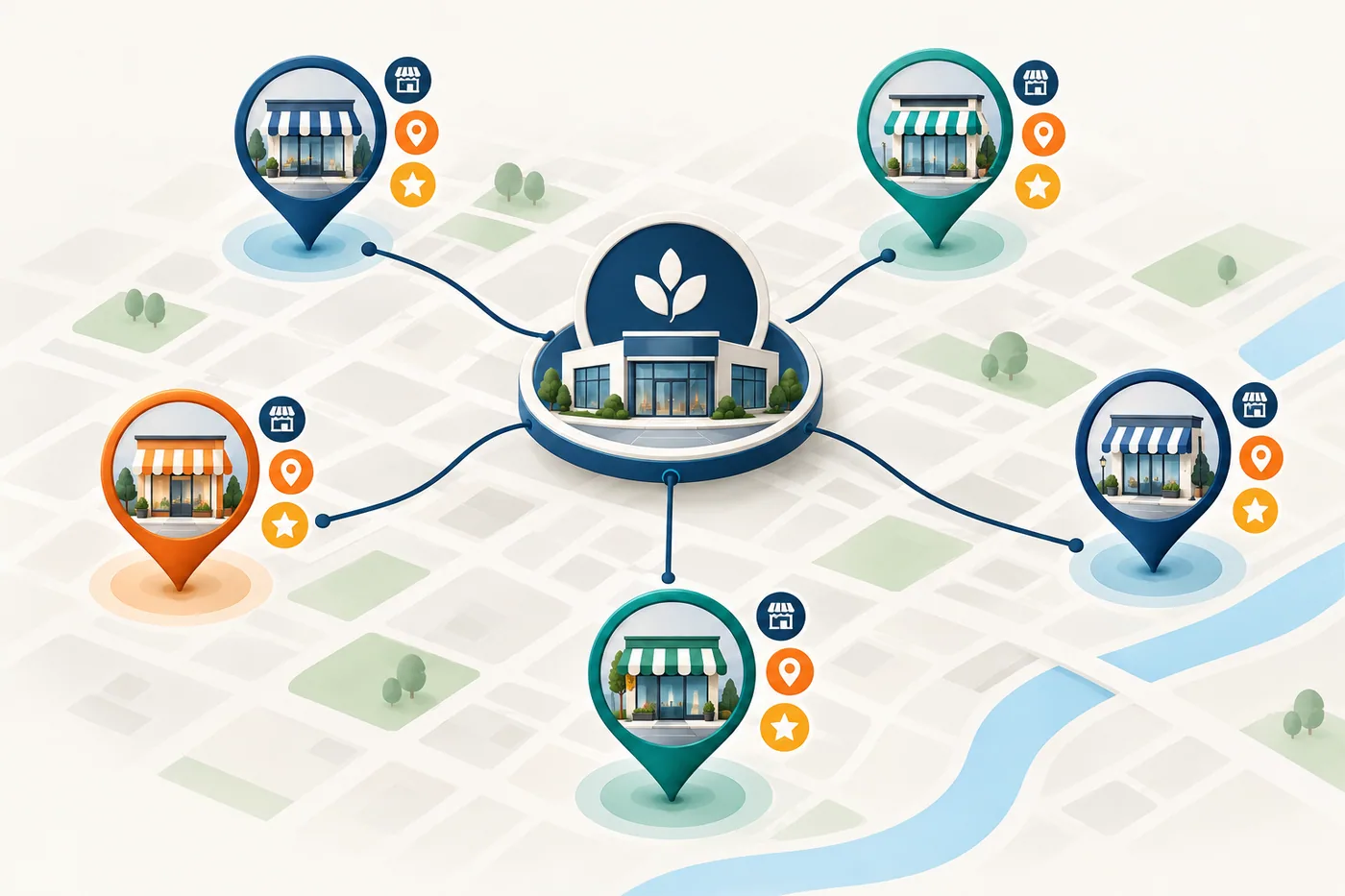
Franchise SEO coordinates organic and local search work across a network so customers can find accurate information for the right branch. It combines a navigable website structure, useful location pages, maintained business listings, clear editing responsibilities, and location-level measurement. The practical test is whether a customer can find a nearby location, confirm what it offers, and contact it—and whether your team can keep that information current as branches change.
For franchise owners and multi-unit operators, the work is less about chasing a single ranking than managing the path from search to the correct location. Start by checking a sample of branches: do their pages and public listings agree on address, hours, phone, and services? This guide explains what to review and who should own each part.
What franchise SEO includes
Franchise SEO applies established organic and local-search practices across a network; it is not a separate search-engine rulebook. It usually spans five connected areas:
- Site architecture: A clear route from the main site and location finder to each branch’s page.
- Location-page quality: Accurate, distinct branch information rather than a template that only swaps a city name.
- Business listings: Correct location facts on public profiles and relevant directories.
- Brand and local governance: Rules for who can edit names, addresses, hours, services, and local content.
- Measurement: Reporting that distinguishes network-wide demand from performance at individual locations.
These components work as a system. A correct listing that sends visitors to an outdated page creates a poor customer path. A useful page cannot make up for a wrong phone number shown elsewhere. The goal is a reliable route from search to the right branch, supported by an operating process that keeps the facts aligned.
Why it matters in a multi-location business
A single-location business often manages one set of contact details, one local profile, and a small group of pages. A franchise network has repeated information and shared decision-making. Corporate may own the website and standards; local operators may know the branch’s hours, services, and community context. Without an agreed process, hours go stale, pages become thin or duplicated, and teams may not know who can approve an update.
Those are operational problems as much as marketing problems. Information needs to be collected, checked, approved, published, and corrected in a dependable way. Franchise SEO supports two different discovery needs:
- Brand-level discovery: A person is researching the company, its services, or its broader offering.
- Location-level discovery: A person needs a nearby branch, local availability, directions, or contact details.
A network needs to support both without making every page compete for the same broad query. For a closer look at how the operating model differs from SEO for a single business, read this comparison of local and franchise SEO.
How the main parts fit together
1. Build a navigable location structure
Each active branch needs a stable, crawlable destination linked from a location finder or an equivalent route. Use a URL pattern that people can understand and your team can maintain as branches open, close, or move. Customers should not have to guess which page belongs to a particular branch.
Decide who creates and retires location pages, how names and addresses are recorded, and what happens to a page when a branch relocates or closes. The right structure depends on the number of locations, services, and how customers choose a branch; there is no universal page-count formula. For more on deciding what each branch page should contain, see the location-page planning guide.
2. Make each location page useful
A page should answer practical questions about that specific branch. Depending on the business, include:
- Official location name, address, phone number, and current hours.
- Services actually available there, including meaningful limitations.
- Directions, parking or access information where relevant, and a clear contact or booking action.
- Verified local details that distinguish the branch, such as its service area or operating information.
Do not manufacture uniqueness by replacing a city name in otherwise identical copy. When branches offer the same services, accurate location facts and practical details can still make a page useful. Keep every claim specific to what that branch can deliver.
3. Keep public location data under control
Maintain one source of truth for core details and name the people responsible for changes. Set a routine to check profile ownership, hours, phone numbers, addresses, and links to the correct branch page. When information changes, document who requested it, who approved it, and who verified that it is live.
A simple change log makes that process auditable. Track the location, field changed, request date, owner, approval status, and verification date. If the website and a public profile disagree, the record helps the team find the source of the error instead of relying on memory.
4. Set governance that allows local relevance
Corporate teams generally need control over brand identity, core service descriptions, and technical standards. Local teams can contribute verified branch and market details. Put the boundary in writing. For example, a franchisee might submit a local event or service-area update, while corporate reviews content that changes a core brand claim.
Document who creates pages, who approves edits, how hours are corrected, and what happens when ownership changes. Clear answers prevent updates from waiting indefinitely or being published without review.
Franchise SEO review: a practical checklist
| Area | What to check | Warning sign |
|---|---|---|
| Location architecture | Every active branch has a clear, accessible page linked from the site. | Pages are orphaned, duplicated, or hard to find. |
| Page accuracy | Address, contact details, hours, and available services are verified. | Template copy includes incorrect or unsupported local claims. |
| Listings | Profiles are owned and updated through a known process. | No one knows who controls a profile or where updates originate. |
| Governance | Corporate and local editing responsibilities are documented. | Changes wait indefinitely or appear without review. |
| Measurement | Reports show location-level outcomes and whether tracking is complete. | A network average hides branches with missing or unreliable data. |
How to measure without hiding location differences
Start with measures tied to customer actions and data quality: organic visits to location pages, calls or bookings where tracking is reliable, and whether each active branch has complete, correct location information. Review results by branch and across the network. A single average can hide a broken page or a phone number that is not being tracked.
Before comparing branches, confirm that the reporting definitions are consistent. Specify which URLs count as location pages, what qualifies as a lead, and how calls or bookings are attributed. Check that tracking works for each branch and record missing data instead of treating it as zero. A change in visits alone does not prove which SEO task caused it; demand, competition, seasonality, site changes, and tracking quality may also affect the result.
For local visibility, review branches in their actual service areas and compare like with like over time. One national rank or network-wide average is not a complete picture of local discovery.
What franchise SEO is not
- Not just adding city names. Location copy should reflect verified branch information and help visitors.
- Not one central page for every market. Customers need a clear route to the relevant branch.
- Not a promise of a particular position. Results vary, and no responsible plan can guarantee a rank.
- Not a one-time cleanup. Locations open, close, change hours, and update services; operations need to keep pace.
A sensible first step for franchise operators
Select a small sample of branches and trace the customer path: search for the brand and a local service, open the result, verify the page details, follow its contact action, and check whether the public listing points to the same branch. Record each defect, its owner, and how it will be verified. Classify the issue as page content, listing data, technical setup, or unclear ownership.
If basic information is inconsistent, correct the source data and ownership process before expanding content production. If those basics are sound, prioritize pages around real customer questions and services each branch actually provides. Web Market Florida’s franchise SEO guidance is one reference for considering how this work can be organized across a network.
FAQ
What is franchise SEO?
It is the coordinated application of organic and local SEO across a franchise network, combining brand-wide website structure with accurate, useful information for each location.
How is franchise SEO different from local SEO?
Local SEO may focus on one business and its market. Franchise SEO coordinates many locations while preserving accurate local details and consistent brand standards. The tactics overlap; the operating scale and governance differ.
Does every franchise location need its own page?
Each active location needs a clear, useful online destination when customers need its specific details. The page structure should reflect real customer needs and branch information, not a fixed formula or thin duplicate pages.
Who should manage franchise SEO?
Usually, corporate owns shared standards and the site framework, while local operators supply or verify branch-specific facts. The precise split depends on the franchise model, but responsibilities should be documented.
Next step
Use the checklist to audit a sample of branches, assign owners to the gaps, and verify each correction on the page and listing where it appears. That gives the team a practical baseline for deciding what to fix before scaling the work.