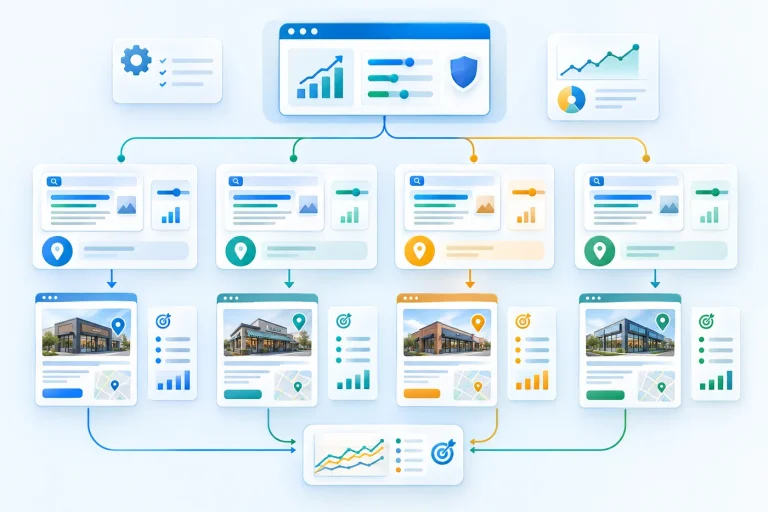
Managing Google Ads for several franchise locations is not mainly a naming exercise. It is an operating-system problem. Your structure must let the central team protect the brand, let local operators act on useful data, and show which locations turn advertising into qualified leads or sales.
The practical starting point is a shared account structure with campaigns separated by intent, service, and geography where those differences affect budget or messaging. Avoid building one giant campaign for every location, but do not split campaigns so aggressively that each has too little data to optimize.
This guide explains how to make that decision, how to organize campaigns, and how to report performance without losing the local detail that franchise operators need.
Before creating campaigns, write down the decisions the account needs to make. A multi-location program usually needs answers to five questions:
These questions matter because account structure should follow management needs. If a location needs its own budget, message, landing page, or lead-quality review, separation may be justified. If not, a shared campaign may be simpler and more stable.
A workable franchise Google Ads account structure has three layers:
Keep these layers distinct. A location name should not be buried in an ad group if that location needs a different budget. Likewise, a service should not be split into separate campaigns merely because it has a different keyword list unless budget, targeting, or reporting also needs to differ.
There is no universal rule that says every franchise location needs its own campaign. Use a location-specific campaign when one or more of these conditions apply:
Use shared campaigns when locations offer the same service, operate under similar rules, and can tolerate pooled budget decisions. Shared campaigns reduce duplicated maintenance. Separate campaigns increase control. The correct choice depends on the trade-off, not on the number of addresses alone.
| Campaign group | Use it for | Separate when |
|---|---|---|
| Core service | High-intent searches for the main service | Service budgets or lead values differ |
| Brand | Searches containing the company or franchise name | Brand policy or location coverage needs separate control |
| Local service | Queries tied to a city, neighbourhood, or branch | Locations need distinct budgets, pages, or offers |
| Priority service | A service with a different margin or sales process | Its value and conversion definition differ |
Do not copy this table mechanically. A small network may need only a few campaigns. A larger network may need campaign families by service and market. The test is whether each split produces a management benefit that justifies more upkeep.
Each campaign should have a documented location rule. Record the included areas, excluded areas, radius or boundary logic, and the option controlling whether ads reach people physically present in the area or people showing interest in it. Review this setting when the business serves customers locally; otherwise, impressions can be attributed to a market the location does not actually serve.
Use a location naming convention that is readable in reports. For example:
Search | Core Service | OrlandoSearch | Core Service | Winter ParkSearch | Brand | Kissimmee
The exact format is less important than consistency. Include the network, intent, service, market, and status where useful. Document abbreviations so a new operator can understand the account without asking the original builder.
Central teams should own the non-negotiables: approved brand names, legal language, offer terms, core value propositions, tracking requirements, and landing-page standards. Local teams can usually contribute approved variations such as neighbourhood references, opening hours, parking information, and service-area details.
Use an approval process rather than allowing unrestricted local edits. A simple workflow is:
This keeps local ads useful without creating dozens of unreviewed promises.
The ad and landing page should agree on service, location, offer, and next step. Sending every location search to a national homepage makes reporting harder and often forces the visitor to repeat the search for a local answer.
A location landing page should make basic facts easy to confirm:
Track calls, forms, booked appointments, purchases, or other meaningful actions. A click is a delivery signal, not a business outcome. If a location cannot define its qualified lead, the account cannot reliably compare locations.
For a broader look at paid-search planning, see this Google Ads resource from Web Market Florida. Treat it as general guidance and adapt the operating rules to your franchise agreement, market, and tracking setup.
Do not divide the total budget evenly by location unless the locations have similar demand, capacity, and economics. Start with a documented allocation method. Possible inputs include:
Budget rules should also include a review trigger. For example, a location may be considered for more budget when it is losing eligible impression share while the sales team has capacity. It may need less budget when leads are being missed, rejected, or left unanswered. The exact threshold should come from the business’s own economics, not a generic benchmark.
Franchise reporting has to work for both the network and the individual location. A network view helps central leaders see total spend, qualified conversions, cost per qualified conversion, and service mix. A location view helps operators act on missed calls, weak landing pages, search-term quality, and follow-up speed.
| View | Useful questions |
|---|---|
| Network | Which services and markets deserve more or less investment? |
| Location | Are leads relevant, answered, and followed up? |
| Campaign | Is budget reaching the intended search intent? |
| Landing page | Does the page turn local demand into a meaningful action? |
Use the same definitions across locations. If one branch counts every form and another counts only sales-qualified enquiries, a network comparison is misleading. Include a data dictionary that defines each conversion, owner, source, and reporting delay.
More campaigns do not automatically create more control. Excessive splitting can spread activity thinly, duplicate negative-keyword work, and make quality checks harder. Split when the operational benefit is clear.
Different services may have different customers, values, sales cycles, and landing pages. Combining them can hide which offer is consuming budget or producing weak leads.
Calls, quote requests, directions, bookings, and purchases should not automatically carry the same meaning. Classify actions by business value and verify that the tracking reflects what the location actually wants.
Lead forms are not the finish line. If the CRM can connect enquiries to appointments, sales, or disqualified leads, feed that information into the review process. Otherwise, the account may optimize for volume rather than useful demand.
Inconsistent names create manual work and make mistakes more likely. Maintain a naming template, change log, and owner for account governance.
The best Google Ads structure for a multi-location brand is the smallest structure that preserves the control the business genuinely needs. Separate campaigns when budget, targeting, service, landing page, or reporting requirements differ. Keep shared elements centralized. Give local operators accurate information without turning every branch into an independent advertising system.
If the account is difficult to explain, difficult to report on, or unable to distinguish qualified leads from raw actions, restructure the operating rules before adding more campaigns.
No. Give a location its own campaign when it needs distinct budget, targeting, messaging, landing-page, or reporting control. Otherwise, a shared campaign may be easier to maintain.
Often, a shared account supports centralized governance and consistent conversion definitions. Separate accounts may be appropriate when ownership, billing, policy needs, or business operations are genuinely separate. Document the reason before deciding.
Use a network summary plus location-level views. Keep conversion definitions consistent, and connect advertising actions to lead quality wherever the CRM permits.
Map locations, services, landing pages, budgets, and conversion owners. Then create only the campaign splits that support a real management decision.
A practical guide to structuring Google Ads for multi-location and franchise brands, including account ownership,…
Looking for Curry Ford Waterford Lakes desserts? Use this neighborhood guide to plan a Colombian…
Apopka has quietly become one of the most enjoyable brunch destinations in Northwest Orlando, offering…
Narcoossee Road has quickly become one of the busiest and most vibrant dining corridors in…
How to Measure Ring Size: A Clear, Practical Guide Short answer: The most reliable way…
Lab-Grown Diamonds: Why They’re Redefining Engagement Ring Trends For a long time, the idea of…