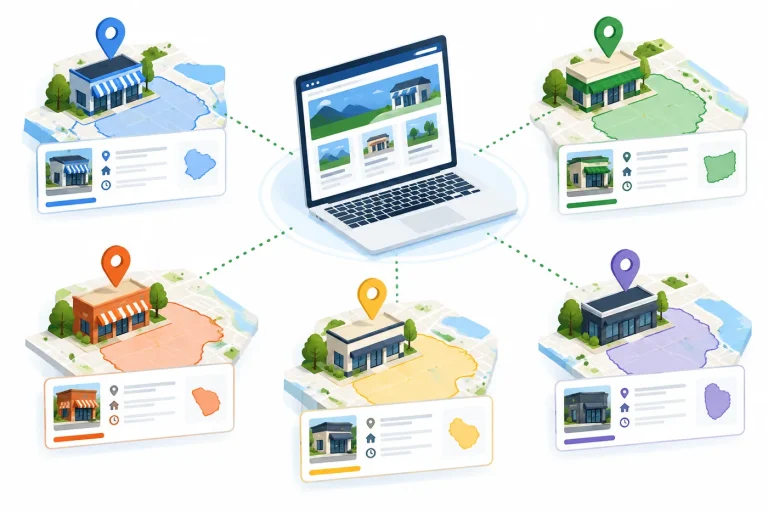
Most franchises do not need one dedicated landing page per location on day one. The right number depends on whether each location has a distinct market, service mix, customer journey, and set of facts worth presenting. A useful starting point is to build pages for locations that serve clearly different areas or have enough operational detail to support a genuinely useful page. Then expand when search data, lead quality, and conversion performance justify the work.
This guide explains how to plan franchise landing pages without creating a large set of near-identical URLs. It covers the signals that justify a page, the information every location page should contain, and a simple decision process for networks ranging from two locations to twenty or more.
A dedicated page is usually justified when a customer would expect a different answer based on location. That difference might involve service availability, opening hours, staff, appointment process, delivery radius, local proof, or the area served.
A page is harder to justify when the only change is the city name. Replacing “Orlando” with “Winter Park” in an otherwise identical template does not create a useful local resource. It creates maintenance work and can leave visitors unsure whether the location is real, active, or relevant to them.
Think of each page as an operational promise. If the business can keep the promise accurate and useful, the page may earn its place. If it cannot, a well-built locations hub or regional page is often the better choice.
Separate pages make sense when branches have different service areas or customers search for them using different place names. A Kissimmee location may serve a different set of neighborhoods from a Lake Nona location. An Altamonte Springs branch may have different access instructions and operating hours from an Orlando branch.
Use the actual service footprint, not just the nearest city label. A location page should explain where the branch serves customers and whether service is delivered, appointment-based, mobile, or restricted to a defined radius.
If customers book with a specific branch, call a local number, visit a local address, or receive different instructions, a dedicated page can remove friction. The page should make the next step obvious.
Useful location-specific details may include:
If every branch sends customers through the same central process, a shared page may be enough until local demand or performance shows otherwise.
A location deserves its own page when its service menu is meaningfully different. One branch may offer emergency appointments, while another handles scheduled work only. One may serve commercial customers, while another focuses on residential jobs.
Do not list every network-wide service on every page. A visitor should be able to tell what this specific location does, what it does not do, and how to confirm availability.
Useful local proof can include branch-specific team information, photographs, completed work that can be discussed honestly, local partnerships, community involvement, or reviews displayed through an appropriate first-party system. The point is not to decorate a template. The point is to help a customer decide whether this location is credible and convenient.
Do not create fictional testimonials, generic “serving the community” paragraphs, or vague claims about local expertise. If a branch has no distinctive proof yet, that is a reason to improve the operation before multiplying pages.
This is the constraint many networks overlook. Every location page needs an owner. Someone must update hours, services, staff, forms, phone numbers, promotions, and local information when they change.
A page that ranks but sends customers to a disconnected phone number is not a marketing success. Before launch, assign responsibility for updates and define a review schedule. A small network can often review pages monthly or quarterly. Larger networks may need a central content system with local approval.
| Network situation | Recommended page structure | What to verify first |
|---|---|---|
| One to two nearby locations with the same services | One strong locations page, plus a dedicated page only where customer details differ | Whether addresses, hours, service areas, and booking paths are genuinely different |
| Three to five locations in separate communities | Dedicated pages for locations with distinct service areas and local information | Local demand, accurate branch data, and unique conversion paths |
| Six to ten locations with mixed services | Location pages supported by service pages and a clear locations hub | Which branches offer which services and who owns updates |
| Ten to twenty locations | Use a repeatable page system with structured local fields and human review | Data governance, duplicate-content risk, analytics by location, and approval workflow |
| Twenty or more locations | Prioritize pages by market value and operational readiness instead of publishing all at once | Branch-level demand, lead routing, page quality, and the ability to maintain the network |
Rank locations using a simple scorecard. The scoring does not need to be complicated. It needs to make tradeoffs visible.
| Factor | Question | Evidence to collect |
|---|---|---|
| Market distinction | Does this branch serve a recognizably different area? | Service boundaries, customer addresses, local search queries |
| Service distinction | Does this branch offer something others do not? | Approved service list and branch capabilities |
| Customer intent | Would a visitor expect a local answer? | Calls, bookings, form submissions, and search-console query themes |
| Conversion value | Can the page move a customer to a clear next step? | Local phone, booking flow, form routing, and tracking setup |
| Content depth | Can the page include real, useful local information? | Staff, photos, access details, service notes, and local proof |
| Maintenance readiness | Can the business keep the information current? | Page owner, update process, and review date |
Build the highest-value, highest-readiness pages first. A smaller group of accurate pages is more useful than a complete directory of thin pages.
A dedicated page should answer the questions a visitor has before contacting the business. It should not be a copy of the corporate homepage with a local heading.
Keep network-wide information consistent, but allow the local facts to do real work. Brand consistency should cover terminology, design, accessibility, legal details, and calls to action. Local flexibility should cover facts that actually vary.
Use a shared page framework, not shared copy. The framework can standardize headings, structured data fields, calls to action, and navigation. The body should be completed from verified location information.
Before publishing a page, ask:
If the answer to the last question is yes, stop and consolidate. A locations hub can still help users find the right branch. A regional page may be appropriate when several nearby locations share the same service model. The best structure is the one that matches the customer’s decision, not the one that creates the most URLs.
Once pages are live, measure each location separately. At minimum, track:
Traffic alone is not enough. A page can receive visits without producing qualified inquiries. Conversely, a lower-traffic page may be valuable if it consistently helps nearby customers take the next step. Make decisions using a defined period and enough data to avoid reacting to a single week.
For a broader look at planning search visibility across a location network, Web Market Florida’s franchise SEO guide is a useful reference. Treat it as a planning resource, then validate the recommendations against your own branch data and operations.
Use this sequence when adding pages:
The answer to “how many locations need a dedicated landing page?” is not automatically “all of them.” Build a page when the location has a distinct market, customer journey, service mix, or body of useful local information. Use a shared locations page when branches are too similar to support separate experiences. Then expand based on search behavior, qualified leads, conversion data, and the team’s capacity to keep information correct.
If you are unsure whether your current network has too few pages, too many, or the wrong page structure, start with a location-page audit. Map each URL to a real branch, verify the local details, review the conversion path, and identify pages that should be expanded, combined, or removed.
No. A dedicated page is useful when the location has distinct customer or service information. Similar branches may be better represented by a locations hub or regional page.
Yes. A shared template can protect brand consistency and make maintenance easier. The local facts, service details, contact route, and supporting content should be verified for each branch.
There is no reliable word-count threshold. The page needs enough accurate information to help a customer choose, contact, or visit that location. Useful substance matters more than padding.
Not necessarily. A phased rollout lets the business test page quality, lead routing, tracking, and maintenance before applying the system across the entire network.
Next step: Audit your location inventory and choose the first pages based on market distinction, customer value, and maintenance readiness.
If you are comparing Edgewood and Waterford Lakes for coffee, choose the Mecatos location that…
Local SEO serves one location. Franchise SEO adds the governance, templates, permissions, and reporting needed…
Compare single, multiple and hybrid Google Ads account structures for franchise brands, including billing, access,…
A practical framework for setting and managing franchise PPC budgets across multiple locations without wasting…
A practical guide to comparing Mecatos MetroWest and Apopka, including menu categories, hours verification, parking…
A practical guide to structuring Google Ads for multi-location and franchise brands, including account ownership,…